
MK-RC1 / MK-RC2 series · C45E / EN 1.4301 · Ø6 – 50 mm
Rigid Couplings
A rigid coupling is a solid connection between two shafts. Unlike a bellows or disc coupling it has no flexible element: it transmits torque with zero backlash and holds the two shafts exactly in line. That makes it the right choice where the shafts are already aligned and the drive has to be as stiff and as precise as the shaft itself – servo axes, ball-screw drives, encoder shafts and spindles.
MISHKIN rigid couplings use a clamping sleeve to grip each shaft. A slit is closed by high-strength socket screws, so the bore grips the shaft over its full circumference and the torque is carried by friction as well as by a parallel key. The result is a joint with no play in either direction of rotation, a bore held to H8 and a keyway to DIN 6885-1 P9.
There are two executions in carbon steel (C45E) and the same two in stainless steel (EN 1.4301 / AISI 304): the MK-RC1 one-piece sleeve and the MK-RC2 two-piece split sleeve. All four cover bores of 6 to 50 mm in thirteen steps, run up to 4,000 rpm and are available with bores, keyways and overall lengths made to the customer's drawing.
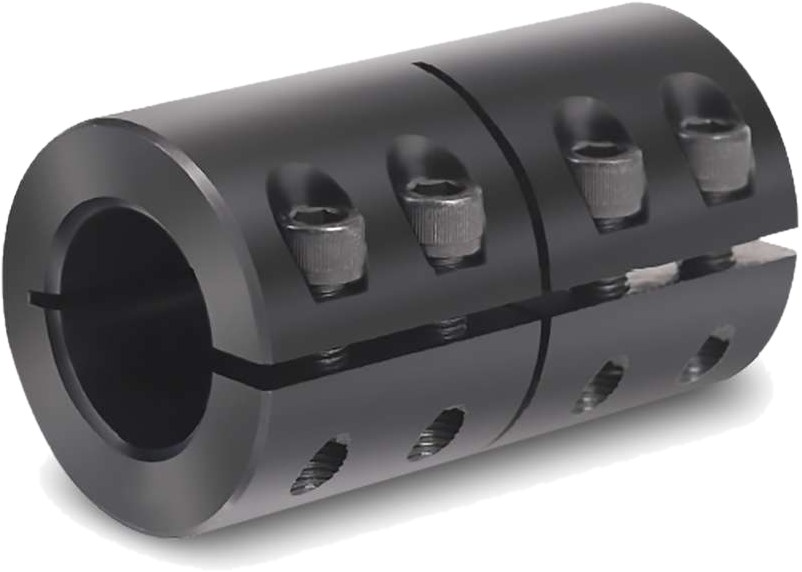
Why MISHKIN rigid couplings
Zero backlash, full torque stiffness. Torque is carried by friction between the clamped bore and the shaft and by the parallel key in the DIN 6885-1 P9 keyway. There is no elastomer to wind up and no clearance to take up on reversal.
Precise, repeatable bores. Bores are held to H8 to ISO 286-2, outside diameter to h13 and overall length to js14. Recommended shaft fits are h6 / k6 for precision drives and h7 for general machinery, with keyway fits to JS9 / P9.
Runs to 4,000 rpm. Every size in the catalogue is rated for a maximum speed of 4,000 rpm with a surface finish of Rz 16 µm (Ra 3.2 µm).
Steel or stainless, same geometry. Carbon steel C45E (EN 1.1191 / AISI 1045) is supplied black-oxide finished; stainless EN 1.4301 (AISI 304) is for corrosive or clean environments. The two materials share the same bore, outside diameter and length for every size.
Carbon steel · C45E (EN 1.1191 / AISI 1045)
MK-RC1 · one-piece clamping30 – 2,250 Nmsee data →
- Single-slit sleeve, four ISO 4762 (DIN 912) class 12.9 screws
- Bores 6 – 50 mm, H8, keyway to DIN 6885-1 P9
- Friction-locked and key-driven at once
- Black-oxide finish, Rz 16 µm, up to 4,000 rpm
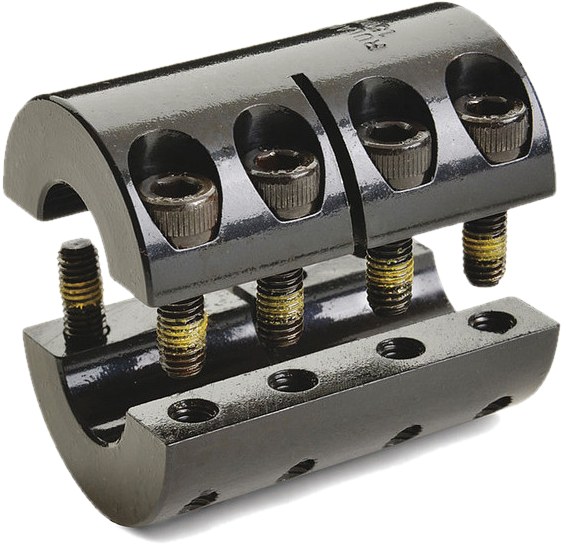
MK-RC2 · two-piece split clamping30 – 2,250 Nmsee data →
- Radial split into two half shells, eight class 12.9 screws
- Fits and removes without moving either shaft
- Same bores, torque and geometry as MK-RC1
- For retrofits and couplings between a motor and a gearbox
Stainless steel · EN 1.4301 (AISI 304)
MK-RC1-SS · one-piece clamping25 – 1,875 Nmsee data →
- Single-slit sleeve, four ISO 4762 A2-70 screws
- Same bores and geometry as MK-RC1
- Clean corrosion-resistant surface
- For food, pharmaceutical, marine and washdown duties
MK-RC2-SS · two-piece split clamping25 – 1,875 Nmsee data →
- Radial split into two half shells, eight A2-70 screws
- Fits and removes without moving either shaft
- Same bores and geometry as MK-RC2
- For stainless drives that need radial assembly
• Full per-size dimensional and torque tables for all four series are in the catalogue linked above.
• All four rigid couplings are zero-backlash designs and do not compensate for radial, angular or axial misalignment; for that, use a bellows or disc coupling.
Rigid couplings: technical data
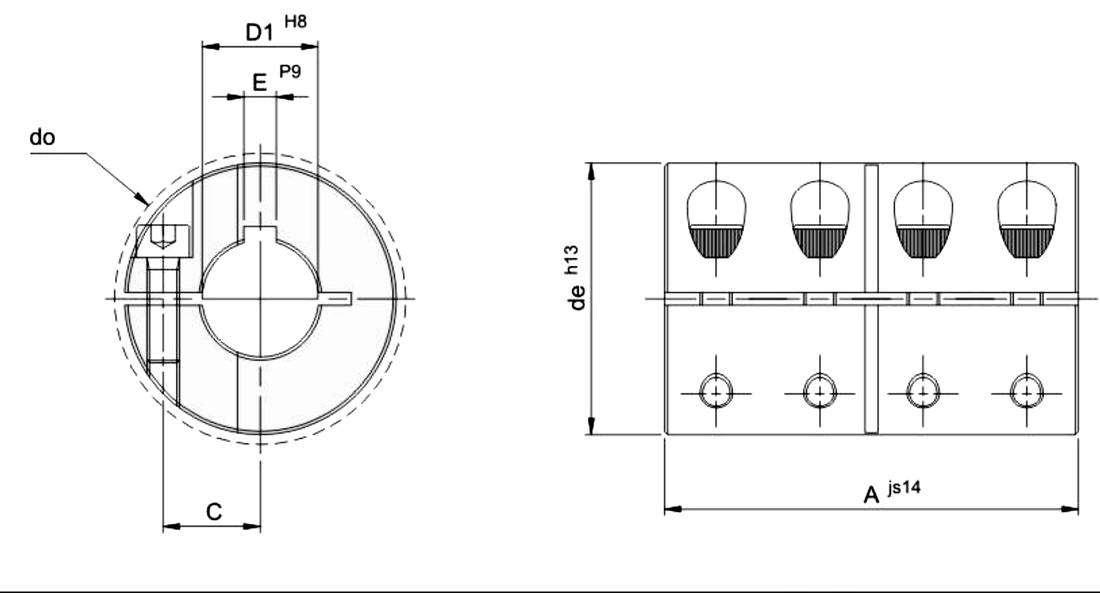
One row per bore. TKN figures are nominal torque: carbon steel applies to MK-RC1 / MK-RC2, stainless to MK-RC1-SS / MK-RC2-SS. The screw-count column reads one-piece / two-piece. Dimensions in mm unless stated.
Sizes are nominal torque in Nm. Where a size lists several values, they correspond to the standard overall lengths offered for that size, in the same order.
Scroll the table sideways to see the larger sizes →
| Parameter | Bore D1 H8 | OD h13 | Clearance do | Length A js14 | TKN carbon | TKN stainless | Pitch C | Keyway P9 | Screws n RC1/RC2 | Screw ISO 4762 | Ts carbon | Ts stainless | Mass |
|---|---|---|---|---|---|---|---|---|---|---|---|---|---|
| 6 mm | 6 | 18 | 21.5 | 30 | 30 | 25 | 5.9 | 2 | 4 / 8 | M3 × 8 | 2.1 | 1.1 | 0.05 |
| 8 mm | 8 | 24 | 27.1 | 35 | 50 | 40 | 9.0 | 2 | 4 / 8 | M3 × 10 | 2.1 | 1.1 | 0.10 |
| 10 mm | 10 | 29 | 33.0 | 45 | 100 | 90 | 10.6 | 3 | 4 / 8 | M4 × 12 | 4.6 | 2.5 | 0.18 |
| 12 mm | 12 | 29 | 33.0 | 45 | 100 | 90 | 10.6 | 4 | 4 / 8 | M4 × 12 | 4.6 | 2.5 | 0.18 |
| 14 mm | 14 | 34 | 39.4 | 50 | 190 | 160 | 12.0 | 5 | 4 / 8 | M5 × 16 | 9.5 | 5.4 | 0.27 |
| 15 mm | 15 | 34 | 39.4 | 50 | 190 | 160 | 12.0 | 5 | 4 / 8 | M5 × 16 | 9.5 | 5.4 | 0.27 |
| 16 mm | 16 | 34 | 39.4 | 50 | 190 | 160 | 12.0 | 5 | 4 / 8 | M5 × 16 | 9.5 | 5.4 | 0.26 |
| 20 mm | 20 | 42 | 48.9 | 65 | 350 | 300 | 15.4 | 6 | 4 / 8 | M6 × 16 | 16.0 | 9.6 | 0.52 |
| 25 mm | 25 | 45 | 51.5 | 75 | 390 | 325 | 16.9 | 8 | 4 / 8 | M6 × 16 | 16.0 | 9.6 | 0.62 |
| 30 mm | 30 | 53 | 58.7 | 83 | 475 | 400 | 20.9 | 8 | 4 / 8 | M6 × 18 | 16.0 | 9.6 | 0.92 |
| 35 mm | 35 | 67 | 74.7 | 95 | 1100 | 925 | 26.7 | 10 | 4 / 8 | M8 × 25 | 39.0 | 23.0 | 1.88 |
| 40 mm | 40 | 77 | 84.0 | 108 | 1325 | 1100 | 31.8 | 12 | 4 / 8 | M8 × 25 | 39.0 | 23.0 | 2.71 |
| 50 mm | 50 | 85 | 94.2 | 124 | 2250 | 1875 | 34.1 | 14 | 4 / 8 | M10 × 25 | 77.0 | 46.0 | 3.52 |
Dimensions
Made to your drawing
- Non-standard bore diameters and fit classes within the 6 – 50 mm range
- Keyway widths to suit your shaft, including JS9 / P9 fits
- Different overall lengths and shortened or extended sleeves
- Material choice: carbon steel C45E or stainless EN 1.4301
- Tell us the remaining parameters and we will confirm what can be made
Frequently asked questions
What is the difference between MK-RC1 and MK-RC2?
MK-RC1 is a one-piece sleeve with a single slit closed by four screws. MK-RC2 is the same sleeve cut into two half shells and bolted radially with eight screws, so it can be fitted and removed without moving either shaft. Bores, torque and geometry are identical.
How accurately must the shafts be aligned?
A rigid coupling does not compensate for misalignment. The two shafts must be aligned to within 0.02 mm TIR before the screws are tightened, using a crosswise, progressive tightening sequence to the stated tightening torque.
Can a rigid coupling be used on a servo axis?
Yes. With zero backlash, a bore held to H8 and a keyway to DIN 6885-1 P9, MISHKIN rigid couplings are used on servo shafts, ball screws and encoder drives where torsional stiffness and repeatable positioning matter.
What speed can they run at?
Every size in the catalogue is rated up to 4,000 rpm. If your duty is different, tell us the speed and we will confirm the selection.
Need a rigid coupling to a specific drawing?
Send the bore, keyway, torque, speed and overall length. We will confirm the size and quote the coupling.