
0.6 – 250 Nm · bore 3 – 45 mm · single and double disc
RIC Servo Disc Coupling – Aluminium, Zero Backlash
The RIC is a lightweight servo coupling built around laminated stainless steel disc packs instead of a bellows. Hubs are machined from wrought aluminium – EN AW-7075 T6 or EN AW-2024 T4 – and the disc packs are EN 1.4310 (AISI 301) spring steel. The combination gives high torsional stiffness at a fraction of the mass of a steel coupling, which is exactly what a fast positioning axis needs: less inertia to accelerate, and less inertia to stop.
Two configurations are available. The single-disc RIC-□-0 is the stiffest and shortest option and takes angular and axial misalignment with a small radial compliance – 0.02 mm, effectively an installation tolerance only. The double-disc RIC-□-T adds a centre spacer with a second disc pack, roughly doubling the radial and axial capacity, which is what a real shaft arrangement usually produces once thermal growth and bearing clearance are added together.
The coupling is rated to DIN 740-2 and ISO 14691, so nominal, alternating and peak torque are stated separately and can be checked against the actual duty cycle. Hubs are supplied in three geometries – A, B and C – to suit small motor shafts, stepped shafts and maximum bore capacity.
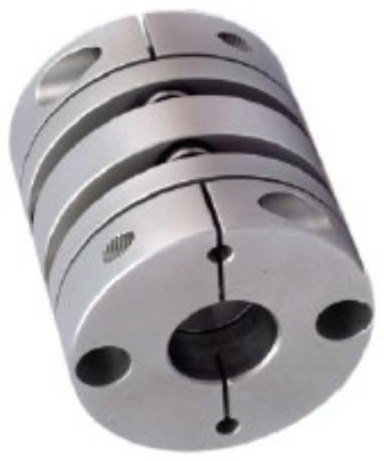
Product features
- Wrought aluminium hubs, EN AW-7075 T6 / EN AW-2024 T4
- Disc packs in EN 1.4310 (AISI 301) stainless spring steel
- 100% zero backlash, metal-to-metal torque path
- Single-disc RIC-□-0 and double-disc RIC-□-T with centre spacer
- Hub styles A, B and C for different shaft steps and bore capacities
- Radial clamping hubs – no keyway needed
- Rated nominal / alternating / peak torque to DIN 740-2, ISO 14691
- Operating temperature -30 °C to +100 °C
- Bores from Ø3 to Ø45 mm, machined to order in H7
Design & materials
Hub styles. Type A has both hubs stepped down to a reduced outside diameter – the lowest inertia, for very fast servo axes. Type B has one stepped and one full-diameter hub, a compromise for small motor shaft to larger driven shaft. Type C uses the full outside diameter on both hubs, giving maximum bore and clamping capacity.
Disc pack. Laminated EN 1.4310 stainless discs, bolted alternately to the two hubs. No sliding surfaces, no lubrication, no wear.
Configuration. RIC-□-0 single disc: shortest, stiffest, angular and axial compensation only. RIC-□-T double disc with spacer: greater radial and axial capacity, for longer shaft spans.
Balance. The rotationally symmetric aluminium hub design keeps inherent balance good; assemblies can be balanced for high-speed spindles on request.
RIC servo disc coupling: technical data
Sizes are nominal torque in Nm. Where a size lists several values, they correspond to the standard overall lengths offered for that size, in the same order.
Scroll the table sideways to see the larger sizes →
| Parameter | RIC-□-0 single-disc | RIC-□-T double-disc |
|---|---|---|
| Nominal / peak torque TKN / TKmax | 0.6 – 250 Nm | 0.6 – 250 Nm |
| Finish-machined bore d1, d2 (ISO 286-2 H7) | Ø3 – Ø45 mm | Ø3 – Ø45 mm |
| Permissible operating temperature | -30 °C to +100 °C | -30 °C to +100 °C |
| Radial offset ΔKr | 0.02 mm (installation tolerance only) | 0.05 – 0.44 mm |
| Angular deflection ΔKw | 0.5° – 1.0° | 1.0° – 2.0° |
| Axial displacement ΔKa | ±0.05 – ±0.74 mm | ±0.10 – ±1.48 mm |
| Disc pack material | EN 1.4310 (AISI 301) stainless | EN 1.4310 (AISI 301) stainless |
| Hub material | EN AW-7075 T6 / EN AW-2024 T4 | EN AW-7075 T6 / EN AW-2024 T4 |
Made to your drawing
- Bores outside the standard range, different at each end
- Keyways to DIN 6885 where a positive connection is required
- Special spacer length on double-disc types
- Stainless hubs for washdown or corrosive areas
- Balanced assemblies for high-speed applications
- Alternative disc pack materials for higher temperatures
Typical applications
Servo drives
Motor to ball screw, low inertia and zero backlash.
CNC machine tools
Axis and spindle drives with high dynamic response.
Linear actuators
Compact coupling for screw-driven modules.
Semiconductor and medical equipment
Clean, lubrication-free operation.
Packaging machinery
High cycle rates with accurate positioning.
Textile and printing machinery
Register accuracy at speed.
Frequently asked questions
Single disc or double disc – which do I need?
Single disc (RIC-□-0) if the two shafts are well aligned and axially short: it is stiffer and shorter. Double disc (RIC-□-T) if the arrangement produces real radial offset or axial growth – a double-disc type accepts roughly twice the misalignment of a single-disc type of the same size.
How much misalignment can the RIC take?
Single disc: 0.02 mm radial (installation tolerance only), 0.5-1.0° angular, ±0.05 to ±0.74 mm axial. Double disc: 0.05-0.44 mm radial, 1.0-2.0° angular, ±0.10 to ±1.48 mm axial. The exact value depends on size.
Is the aluminium hub strong enough?
Yes – EN AW-7075 T6 is a high-strength wrought alloy, and the clamping hub is designed so that the friction joint transmits more torque than the shaft. The limitation is temperature: aluminium hubs are rated to +100 °C, whereas the all-steel RDC series goes to +270 °C.
Can the RIC replace a bellows coupling?
In most servo applications yes, and it is often cheaper. A bellows coupling is stiffer and shorter still, and is preferred where the axial space is very tight or the ambient temperature is high.
Sizing a servo axis?
Send the motor shaft, the driven shaft, the peak torque and the required positioning accuracy; we will select single or double disc and quote it.